All workCase study 03 / 03
SupplyTrace
Catch invalid, duplicate and risky supplier invoices before they're paid. A modular pipeline that ingests raw XML invoices, validates them with deterministic rules, flags duplicates and routes doubtful ones to a review queue, with an experimental ML risk score and a vendor directory.
- Year
- 2026
- Built with
- FastAPI · scikit-learn · Pandas

(01)The problem
Why it existsA bad invoice usually causes trouble later, in a system downstream.
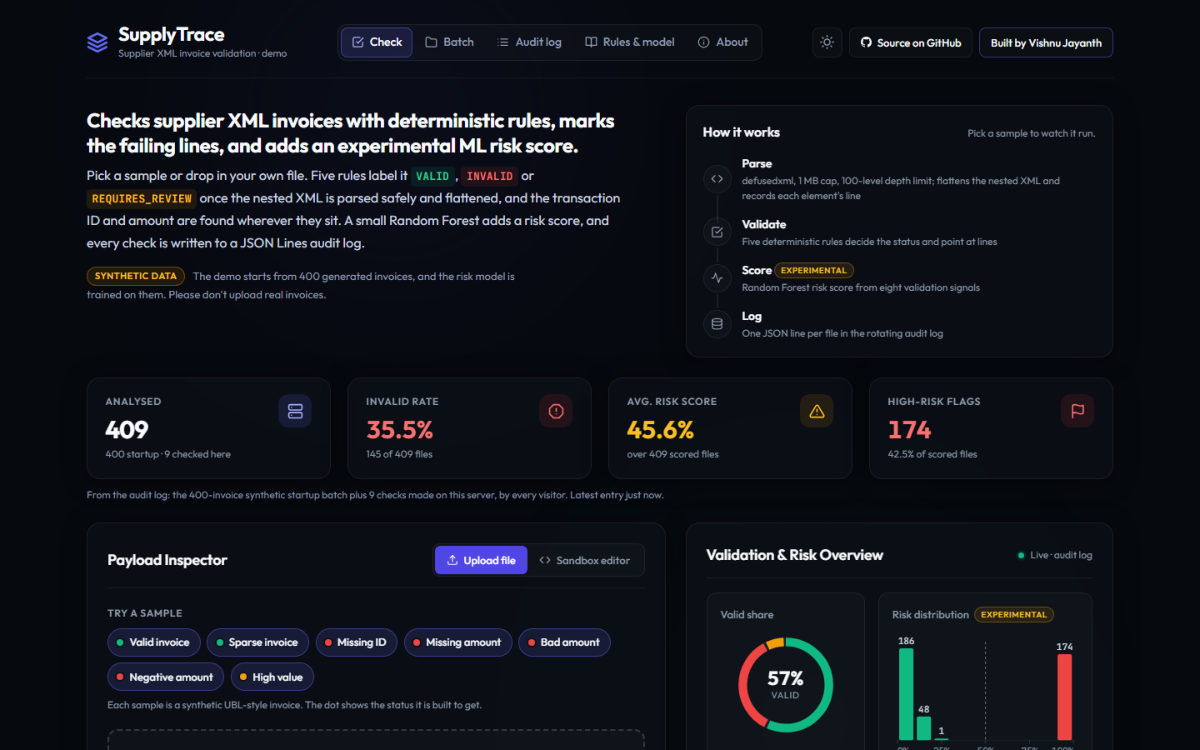
By then it is hard to trace back to the file. SupplyTrace checks each file when it arrives: it labels every invoice valid, invalid or needs review with deterministic rules, points each rule at the line of the file behind it, and logs the result.
An experimental Random Forest adds a risk score trained on 400 synthetic invoices, with an explanation of what drove each prediction.
(02)How it works
From the READMEDashed bracket: the server times each stage and returns it with the rule lines and risk drivers.
Parse safely. The upload is parsed in memory with
defusedxml(no DTDs), files nested more than 100 levels deep are rejected, and uploads over 1 MB get a413. The XML is flattened into dot-notation keys, and a secondexpatpass records each element's line.Validate with rules. Five deterministic rules decide the status:
VALID,INVALIDorREQUIRES_REVIEW. Every rule comes back as a checklist row with the line that shows it.Score the risk (experimental). Eight validation signals go to a Random Forest trained on the synthetic batch; the score comes with the base rate plus one contribution per feature.
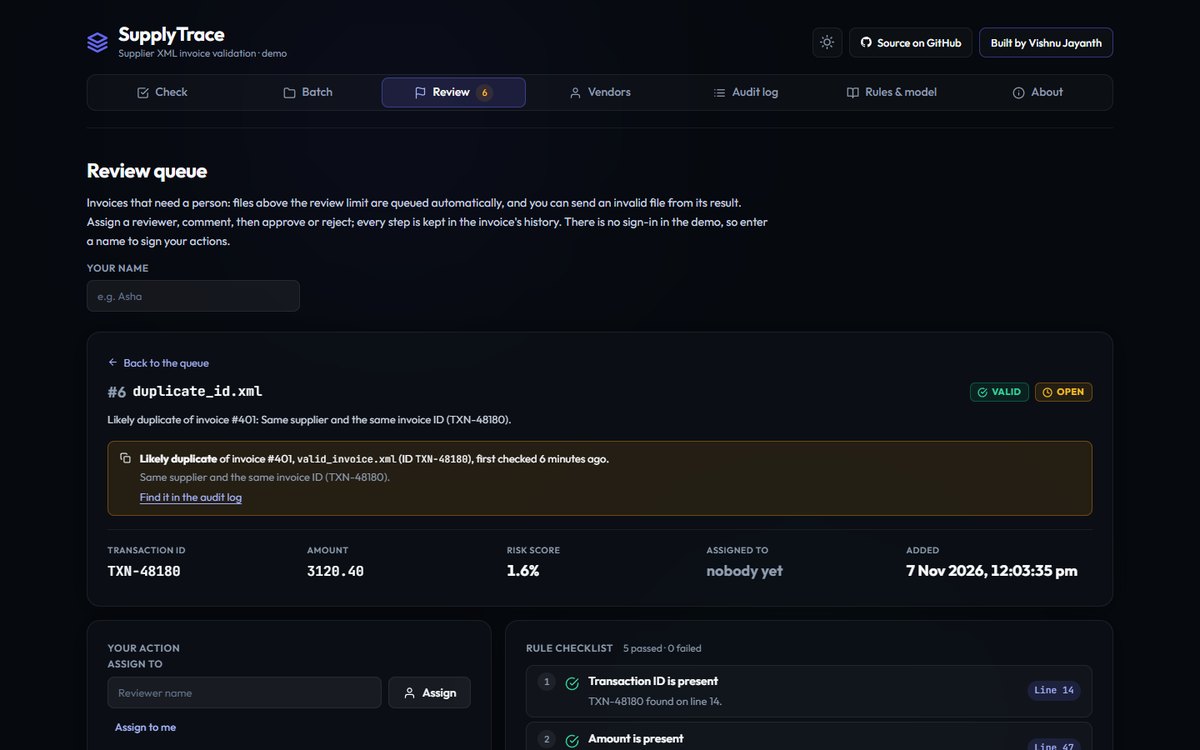
Catch duplicates. Each invoice's SHA-256 fingerprint and key fields are stored. The same content is an exact duplicate; the same supplier and invoice ID, or the same supplier and amount within 7 days, is a likely one and goes to review.
Log it. One JSON line per file goes to a rotating audit log, which also feeds the dashboard.
Review.
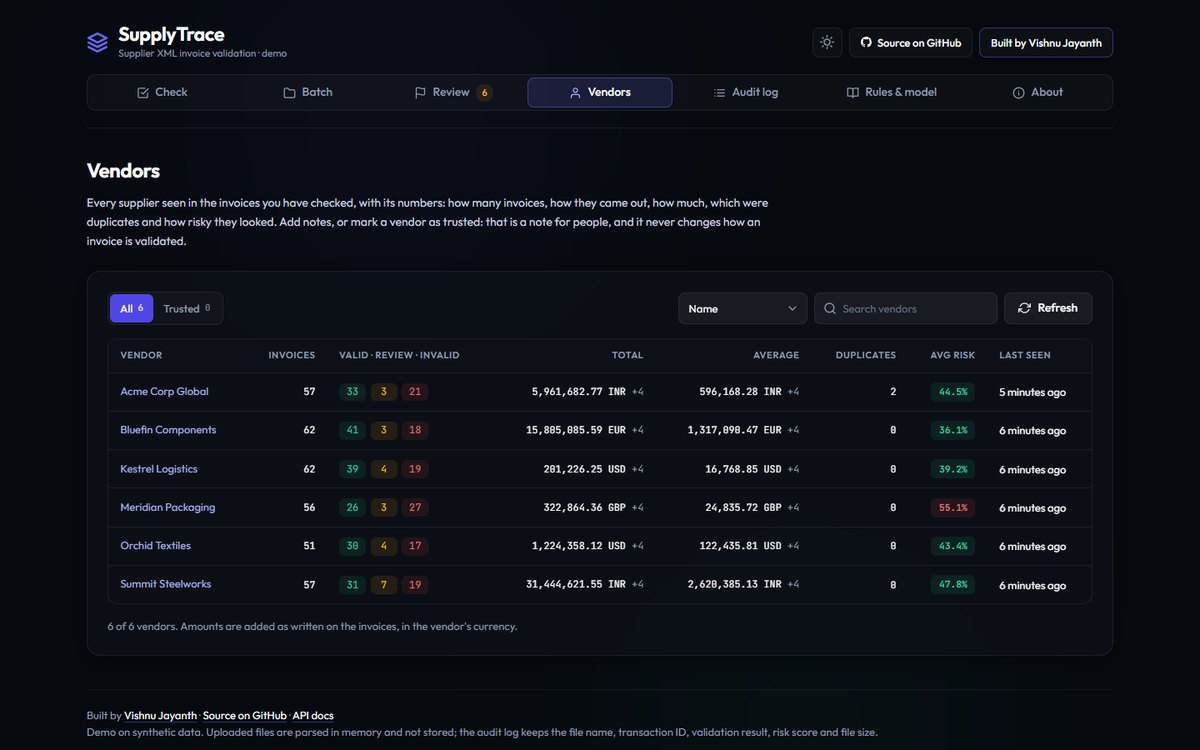
REQUIRES_REVIEWfiles and likely duplicates land in a review queue: assign a reviewer, comment, and approve or reject with a required comment, with an append-only history. A vendor directory rolls the invoices up per supplier.
(03)Key decisions
6 choices-
Rules set the status; the model adds a risk score
The status always comes from five deterministic rules. The risk score is labelled experimental: it is trained on synthetic data and says nothing about real suppliers.
-
Safe parsing of untrusted uploads
defusedxmlrefuses DTDs, so there is no entity expansion or external entities; the 1 MB cap is enforced before the body is read; documents nested more than 100 levels deep are rejected. -
Explaining each risk score
The explanation follows each tree from its root to the file's leaf and credits every split's change in failure rate to the feature it tested (tree-path attribution). The base rate plus the contributions equals the score, and the tests check it.
-
One code path and an audit log
A single check, a batch and a streamed batch all call the same
analyze_document(), so a file gets the same answer every way (tests compare them). Every result is one line in a rotating JSON Lines audit log. -
Compared with a rules-only baseline
The server trains a fresh model on a 75/25 split of the 400 synthetic invoices (300 train, 100 test) and tests it next to a baseline that fails a file exactly when the rules do. At the 50% threshold the model makes the same call as the rules on every held-out file.
-
An append-only review trail
Reviews live in SQLite through SQLAlchemy Core, and any
DATABASE_URLworks. Every action adds a history row, a second decision gets a409, and “Send to review” re-analyses the file on the server, so a client cannot post a made-up result. A vendor’s trusted flag is shown but never changes a validation result, and a test checks that.
(04)Proof
Tests · CI · stack- pytest tests, no network
- 234
- CI on Python 3.11 and 3.12, with Ruff
- Passing
- synthetic invoices the risk model trains on
- 400
The suite covers XML parsing and safety (DTDs, entity expansion, depth and size limits, parse-error positions), every validation rule and every example on the rules page, the risk explanation (it must add up to the score), the single, batch and streamed endpoints (including that they agree), the audit log and the model card's holdout metrics. Review state changes, duplicate detection on crafted invoices and the vendor statistics are tested end to end through the API. An in-process benchmark checked 408 invoices at 28.9 per second (p50 32 ms, p95 48 ms per invoice; method in the README), and CI builds and smoke-tests a Docker image. CI runs
- Python 3.11+
- FastAPI
- Uvicorn
- defusedxml
- SQLAlchemy
- SQLite
- Pandas
- NumPy
- scikit-learn
- pytest
- pytest-cov
- Ruff
- GitHub Actions
- Docker
(05)How it was built
Software development lifecyclePlan. Bad invoice data fails far downstream, where it is hard to trace, so each file is checked on arrival. The scope is written in the README: safe parsing, five rules, a risk score, batches, an audit log, a review queue, duplicates and vendors.
Design. Every file goes through one
analyze_document()pipeline: parse, validate, features, score, audit log. Four tables on SQLite or PostgreSQL, and uploaded XML is never stored.Build. Pinned dependencies, Ruff, one package per pipeline stage, and pull requests since November 2026.
Test. 234 tests in 18 files, run in CI with Ruff on every pull request.
Deploy. Render generates the sample data and runs the pipeline at build time; the model is trained from those results when the app starts. A merge to
maindeploys only after the checks pass, and Render watches/healthz.Maintain. One audit line per check, an append-only review history, and a model card built from the trained model.
Done: an automated acceptance check ran the main user tasks on the live demo at phone and desktop sizes, and every issue an accessibility scan (axe-core) found was fixed, both on 2026-11-09. Not done yet: testing with real users, a staging environment and a smoke test of the deployed build. Latest change, taken through every stage: an end-to-end review found that the risk score read like a probability and gave no next step. The result card now says what the score means and what to do next. The fix was made on a branch, tested, merged through a pull request after CI passed, and deployed. Full SDLC write-up
(06)Screenshots
From the repository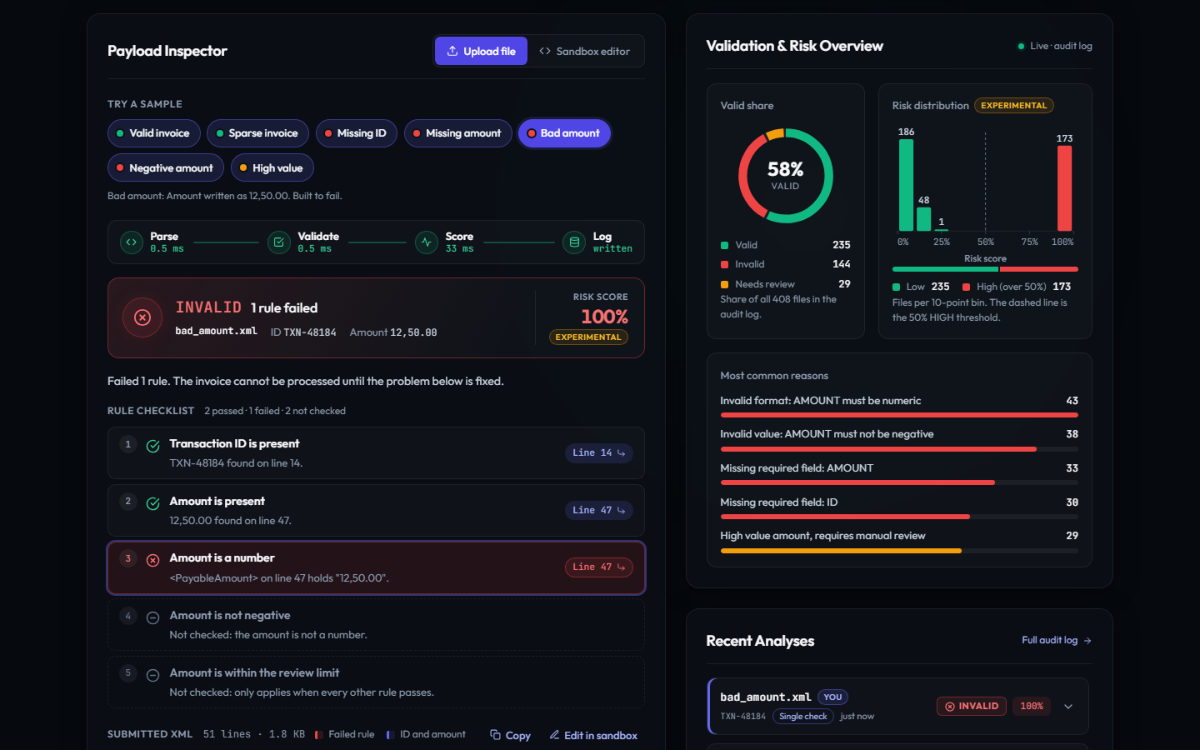
(07)Limitations
Honestly- Synthetic training data. The risk model is trained on synthetic invoices with simulated outcomes; real use would need outcome data, and the scores are not calibrated probabilities.
- Five rules only: no checks on line totals, tax, dates or currencies. Duplicate matching compares suppliers as written, so “Acme Corp” and “Acme Corporation” differ.
- Flattening loses detail. Repeated elements, such as several invoice lines, collapse to the last one, and XML attributes are ignored.
- One shared audit log and review database, reset on every restart on the free host unless
DATABASE_URLpoints at a hosted Postgres. - No saved model. It is retrained at every startup, and there are no accounts or authentication, so reviewer names are self-declared.
Scores any public GitHub repository from 0 to 100 across seven engineering dimensions and checks its dependencies for known vulnerabilities, as a web app, a REST API, a CLI and a GitHub Action.